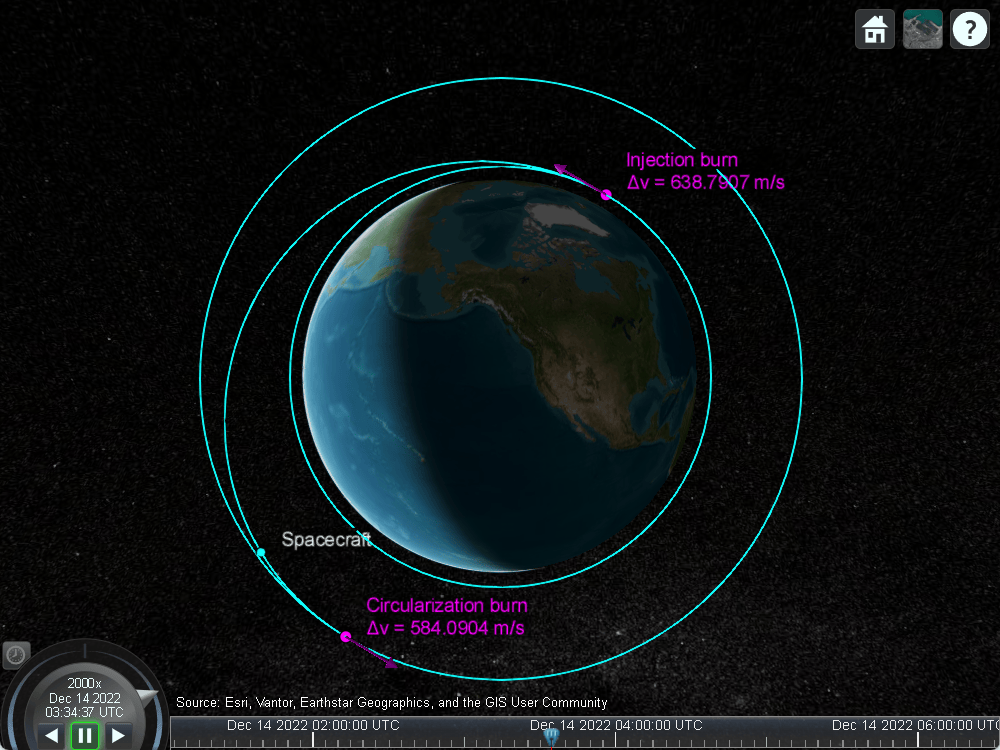
Simulate Hohmann Transfer in Satellite Scenario Using Impulsive Maneuvers
R2026bThis example shows how to model a Hohmann transfer between two circular coplanar orbits using impulsive maneuvers, calculate fuel requirements, and visualize the transfer in a satellite scenario viewer.
Hohmann Transfer Overview
A Hohmann transfer uses two coplanar burns to move a spacecraft between orbits on the same plane. In this example, both orbits are circular. The transfer orbit is an ellipse tangent to the initial and final orbits:
Injection burn at the initial orbit tangent point places the spacecraft on the transfer ellipse.
Circularization burn at the final orbit tangent point inserts the spacecraft into the target orbit.
The transfer angle is 180°. Delta‑V at each burn equals the difference between circular speed and transfer orbit speed at that point, directed tangentially. The time between burns is half the transfer orbit period. Burns are modeled as impulsive for simplicity and efficiency during early mission design.
If the circularization burn is not performed, the spacecraft follows the dashed purple trajectory back to the first tangent point.
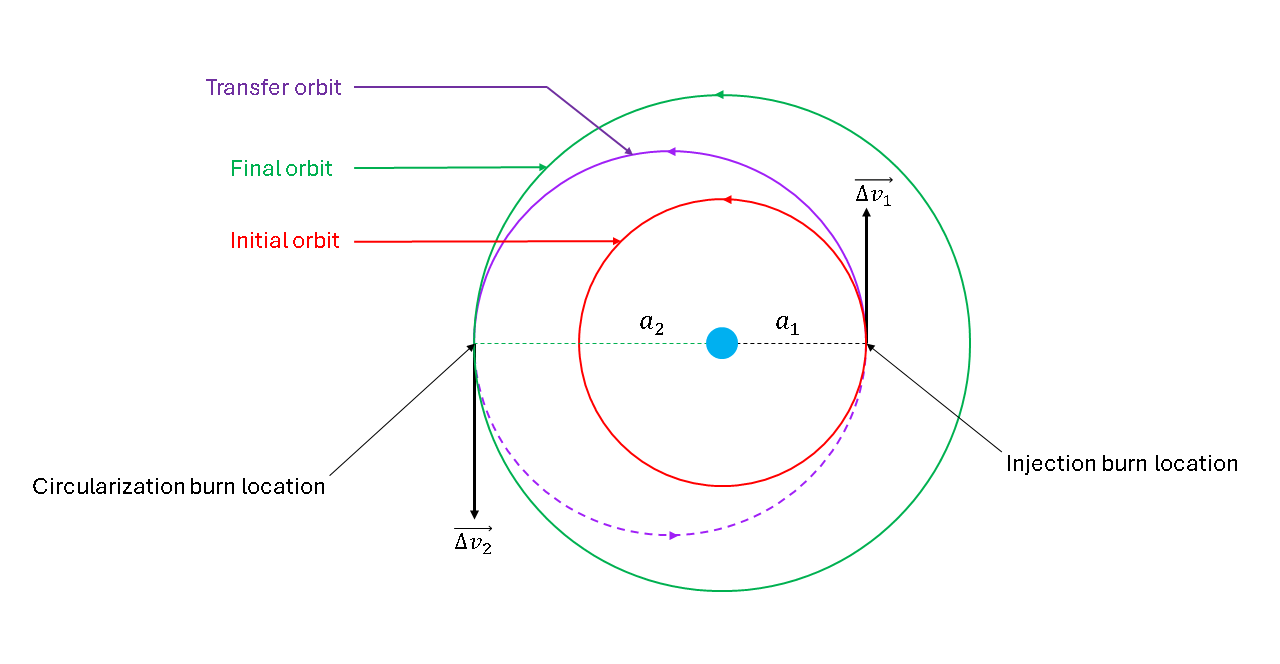
Suppose and are the orbital radii of the initial and final circular orbits. The semimajor axis of the transfer orbit is calculated using this equation:
The velocity magnitude at any given point on the initial circular orbit is:
where is the standard gravitational parameter of the planet (Earth). Immediately following the injection burn, the spacecraft is at the periapsis of the transfer orbit. The corresponding velocity is derived from this energy equation:
where is the velocity on the transfer orbit at its periapsis.
The delta-v for the injection burn () is calculated as:
The direction of is the tangent at the periapsis of the transfer orbit. Similarly, the delta-v for the circularization burn () can be calculated using this equation:
The direction of is the tangent at the apoapsis of the transfer orbit, as illustrated above. The time between the burns is one-half the period of the transfer orbit.
Assume each burn achieves the required velocity change instantly, modeling them as impulsive maneuvers. Use impulsive maneuvers during early mission design for simplicity, analytical solutions in cases like Hohmann transfers, and lower computation cost. They approximate finite burns well when burn duration is short compared to the overall trajectory, which is typical for chemical propulsion missions.
Mission Overview
The mission begins on December 14, 2022, 1:04 AM UTC.
startTime = datetime( ...
    2022, ... % year
    12, ...   % month
    14, ...   % day
    1, ...    % hour
    4, ...    % minute
    0);       % second
Initial orbit parameters are set to:
Semimajor axis = 7,000 km
Eccentricity = 0
Inclination = 45 degrees
Right ascension of ascending node = 90 degrees
Argument of periapsis = 30 degrees
True anomaly = 30 degrees
semiMajorAxisInitial = 7000e3;      % m
eccentricity = 0;
inclination = 45;                   % deg
rightAscensionOfAscendingNode = 90; % deg
argumentofPeriapsis = 30;           % deg
trueAnomaly = 30;                   % deg
Final orbit semimajor axis is 10,000 km.
The spacecraft completes one revolution on the initial orbit, transfers to the final orbit, then completes one revolution there.
semiMajorAxisFinal = 10000e3; % mCalculate Injection Burn Parameters
Define standard gravitational parameter for Earth.
standardGravitationalParameter = 398600.4418e9; % m^3/s^2Calculate the circular speed on the initial orbit.
vCircularInitial = sqrt(standardGravitationalParameter/semiMajorAxisInitial);
Calculate the semimajor axis of the transfer orbit.
semiMajorAxisTransfer = (semiMajorAxisInitial + semiMajorAxisFinal)/2;
Calculate the speed at periapsis of the transfer orbit.
vPeriapsisTransfer = sqrt(2*standardGravitationalParameter* ...
    ((1/semiMajorAxisInitial) - (1/(2*semiMajorAxisTransfer))));
Calculate the delta‑V vector in the VNB frame, where the x‑axis aligns with the velocity vector, the y‑axis aligns with orbital angular momentum, and the z‑axis completes the triad. Because the delta‑V direction is tangential at the transfer orbit periapsis, which is also tangential to the initial orbit, the y and z components are zero.
injectionBurnDeltaVMagnitude = vPeriapsisTransfer - vCircularInitial;
injectionBurnDeltaV = [injectionBurnDeltaVMagnitude;0;0];
injectionBurnReferenceFrame = "vnb";
Schedule the maneuver one orbit period after the mission start because the spacecraft must complete one full revolution on the initial orbit.
initialOrbitPeriod = ...
    2*pi*sqrt((semiMajorAxisInitial^3)/standardGravitationalParameter);
injectionBurnTime = startTime + seconds(initialOrbitPeriod);
Specify a name for the maneuver.
injectionBurnName = "Injection burn";Calculate Circularization Maneuver Parameters
Calculate the speed at apoapsis of the transfer orbit.
vApoapsisTransfer = sqrt(2*standardGravitationalParameter* ...
    ((1/semiMajorAxisFinal) - (1/(2*semiMajorAxisTransfer))));
Calculate the circular speed on the final orbit.
vCircularFinal = sqrt(standardGravitationalParameter/semiMajorAxisFinal);
Calculate the delta-V vector for the circularization burn in the VNB frame.
circularizationBurnDeltaVMagnitude = vCircularFinal - vApoapsisTransfer;
circularizationBurnDeltaV = [circularizationBurnDeltaVMagnitude;0;0];
circularizationBurnReferenceFrame = "vnb";
The circularization burn is executed at the apoapsis of the transfer orbit, which occurs one-half period of the transfer orbit after the first maneuver.
transferOrbitDuration = ...
    pi*sqrt((semiMajorAxisTransfer^3)/standardGravitationalParameter);
circularizationBurnTime = injectionBurnTime + seconds(transferOrbitDuration);
Specify a name for the maneuver.
circularizationBurnName = "Circularization burn";Calculate Propellant Consumption
Given the initial mass , specific impulse of the propulsion system, and the total delta-V , compute the final mass after applying the delta-V using the Tsiolkovsky rocket equation.
where is the standard acceleration of gravity. The difference between the two masses is the total mass of propellant consumed ().
Assume the mass of the spacecraft prior to the injection burn to be 6,000 kg.
initialMass = 6000; % kgAssume specific impulse of the propulsion system to be 310 s.
specificImpulse = 310; % sCalculate the mass of the spacecraft after the execution of both maneuvers.
g0 = 9.80665; % m/s^2
deltaVMagnitudeTotal = injectionBurnDeltaVMagnitude + circularizationBurnDeltaVMagnitude;
finalMass = initialMass/exp(deltaVMagnitudeTotal/(g0*specificImpulse))
finalMass = 4.0129e+03
Calculate the mass of the propellant consumed.
propellantConsumed = initialMass - finalMass
propellantConsumed =
1.9871e+03
Simulate and Visualize Hohmann Transfer in Satellite Scenario
Create a satellite scenario with a start time matching the mission start, a stop time when the spacecraft completes one revolution on the final orbit after the circularization burn, and a sample time of 60 seconds.
finalOrbitPeriod = ...
    2*pi*sqrt((semiMajorAxisFinal^3)/standardGravitationalParameter);
stopTime = circularizationBurnTime + seconds(finalOrbitPeriod);
sampleTime = 60; % s
sc = satelliteScenario(startTime,stopTime,sampleTime);
Add the spacecraft to the scenario based on the orbital elements corresponding to the initial orbit. Set the orbit propagator to "two-body-keplerian".
sat = satellite(sc, ...
    semiMajorAxisInitial, ...
    eccentricity, ...
    inclination, ...
    rightAscensionOfAscendingNode, ...
    argumentofPeriapsis, ...
    trueAnomaly, ...
    OrbitPropagator="two-body-keplerian", ...
    Name="Spacecraft");
Define a timetable out of the calculated maneuvers.
Time = [injectionBurnTime;circularizationBurnTime];
DeltaV = [injectionBurnDeltaV';circularizationBurnDeltaV'];
CoordinateFrame = [injectionBurnReferenceFrame;circularizationBurnReferenceFrame];
Name = [injectionBurnName;circularizationBurnName];
maneuvers = timetable(Time,DeltaV,CoordinateFrame,Name);
Schedule the maneuvers for the spacecraft.
impulsiveManeuver(sat,Insert=maneuvers)
ans = 2×4 timetable
            Time                     Name                       DeltaV              CoordinateFrame    ReferenceCelestialBody
    ____________________    ______________________    __________________________    _______________    ______________________

    14-Dec-2022 02:41:08    "Injection burn"          638.79         0         0         "vnb"                "Earth"
    14-Dec-2022 03:46:08    "Circularization burn"    584.09         0         0         "vnb"                "Earth"

	Get insights using Copilot
Visualize the scenario using satelliteScenarioViewer.
v = satelliteScenarioViewer(sc, ...
    CameraReferenceFrame="Inertial", ...
    PlaybackSpeedMultiplier=2000);
Warning: Graphics acceleration hardware is unavailable. Graphics quality and performance might be diminished. See <a href="https://www.mathworks.com/support/requirements/matlab-system-requirements.html">MATLAB System Requirements</a>.
campos(v, ...
    43, ...    % Latitude, deg
    -97.7, ... % Longitude, deg
    22409300); % Altitude, m
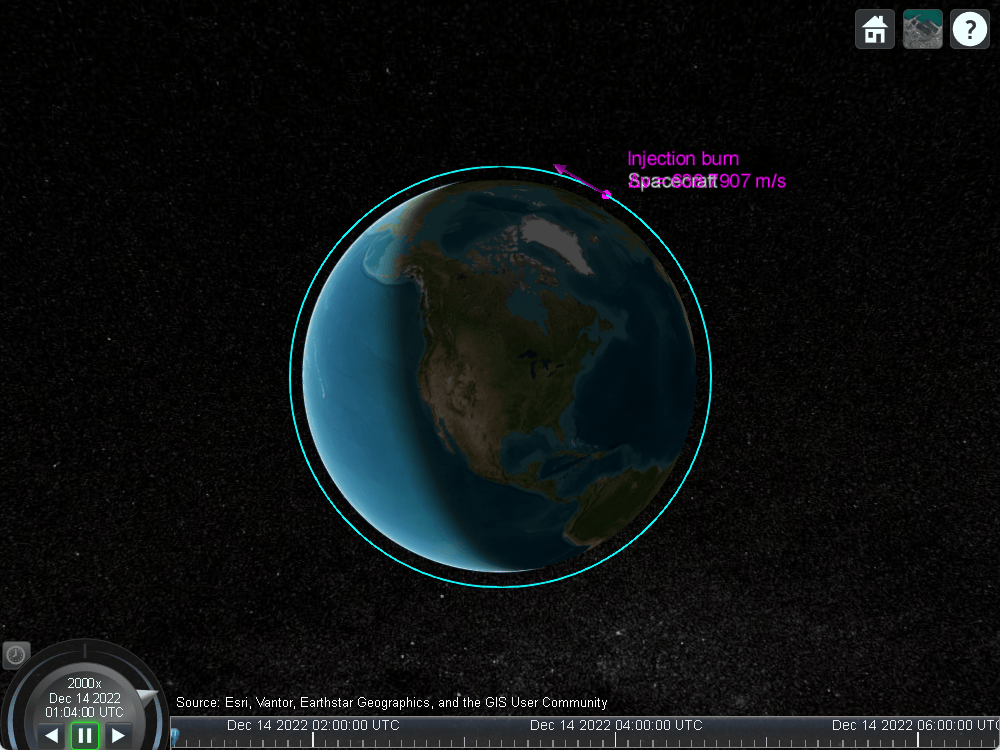
Set the orbit lead and trail times to span the entire scenario duration to visualize the whole trajectory.
sat.Orbit.LeadTime = seconds(stopTime - startTime);
sat.Orbit.TrailTime = seconds(stopTime - startTime);
sat.Orbit
ans =
  Orbit with properties:

                          LeadTime: 1.9680e+04
                         TrailTime: 1.9680e+04
                         LineWidth: 1
                         LineColor: [0.0590 1 1]
    ShowImpulsiveManeuverDirection: 1
        ShowImpulsiveManeuverLabel: 1
                    VisibilityMode: 'inherit'
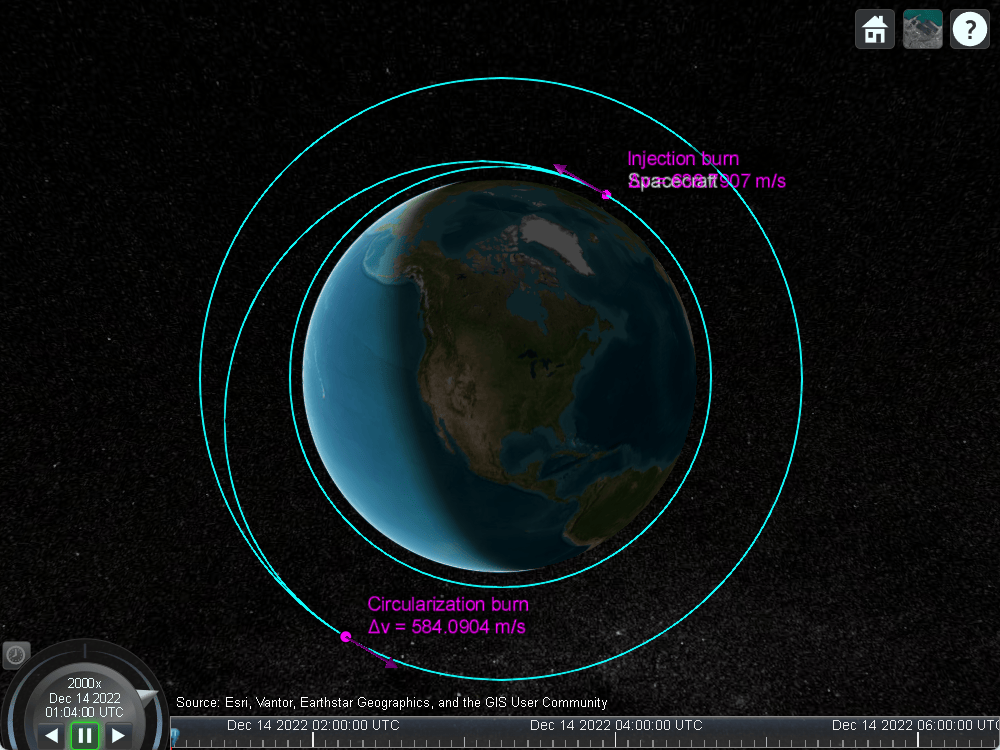
Play the scenario.
play(sc);