Lq Estimator
R2026bEstimate stator inductance (Lq) of permanent magnet synchronous motor (PMSM)
Since R2023a
Lq Estimator block

To add a block to a model, double-click the canvas and start typing the block name. Then, select the block from the list.
Libraries:
Motor Control Blockset /
Control /
Synchronous Machine /
Parameter Estimation
Description
The Lq Estimator block computes the q-axis stator inductance Lq of a PMSM using the phase currents, stator resistance, and the test configuration elements.
The block estimates Lq using either impedance measurement or phase difference measurement. You can use the Estimation technique parameter to select one of these estimation methods.
Impedance measurement (recommended)— The block aligns the rotor to zero electrical position by injecting a constant current Id along the d-axis. It then injects a high frequency current along the q-axis and uses a PI current controller to regulate the current. The block uses the applied voltages and measured currents to estimate the impedance, and the estimated impedance and stator resistance to estimate Lq.Phase difference measurement (for backward compatibility)— The block locks the rotor along the d-axis by injecting a constant voltage Vd. Locking the motor ensures that the rotor remains stationary (aligned with d-axis) during frequency injection. To estimate q-axis stator inductance, the block injects a high-frequency voltage signal along the q-axis and then performs a frequency sweep process by gradually reducing the injected signal frequency using the step size defined by the Step for frequency sweep (Hz) parameter. During frequency sweep, the block monitors the magnitude of the motor phase current. When the injected signal frequency reaches the value of the Minimum frequency (Hz) parameter, the block starts the estimation process by injecting a signal with rising frequency having a step size of Frequency step size for estimation (Hz) with number of steps defined by the Number of frequencies for estimation parameter. To set these parameter values for sweep and estimation, see PMSM Parameter Estimation Configurator.This image shows the frequency sweep and the incremental steps of rising frequency.

The Lq estimation process uses the measured frequency sweep time duration as well as the step size of the changing frequency to estimate Lq.
Examples
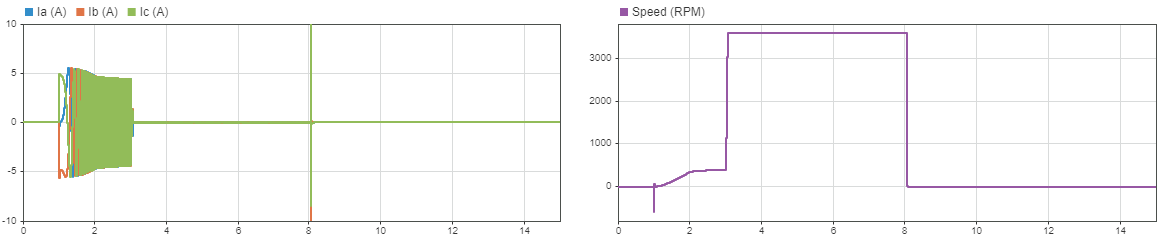
Simulate PMSM Parameter Estimations
Use parameter estimation blocks to simulate PMSM resistance, inductance, and back EMF estimations.
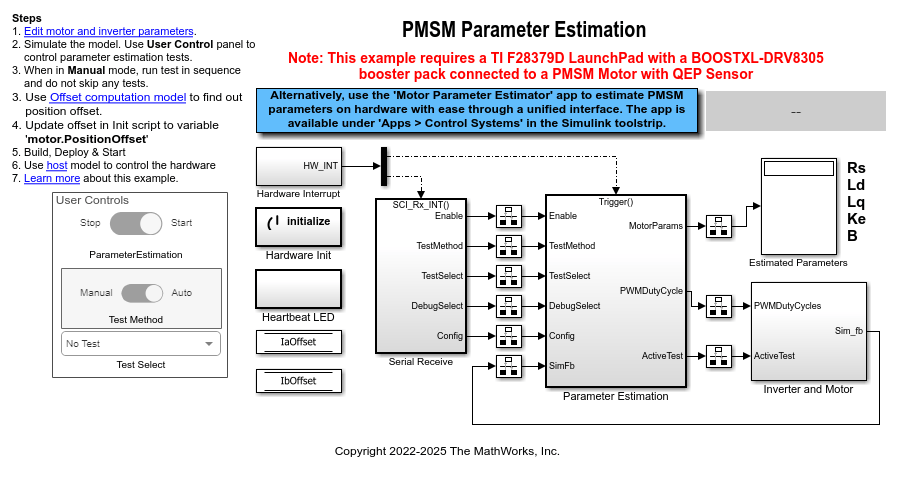
Estimate PMSM Parameters Using Parameter Estimation Blocks
Uses the parameter estimation blocks provided by Motor Control Blockset™ to estimate these parameters of a permanent magnet synchronous motor (PMSM) with a quadrature encoder sensor:
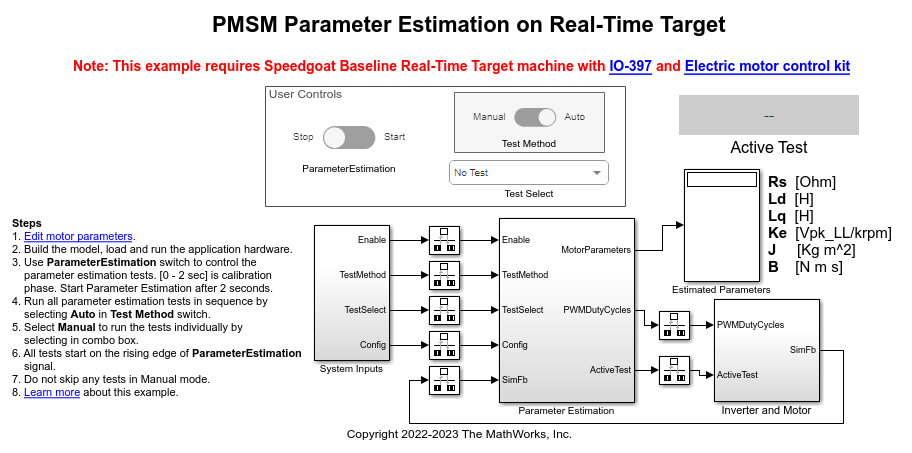
Estimate PMSM Parameters Using Parameter Estimation Blocks on Real-Time Systems
Uses the parameter estimation blocks provided by Motor Control Blockset™ to estimate these parameters of a permanent magnet synchronous motor (PMSM):

