Reservoir (MA)
R2026bBoundary conditions for moist air network at constant or time-varying pressure, temperature, moisture, and trace gas levels
Reservoir (MA) block

To add a block to a model, double-click the canvas and start typing the block name. Then, select the block from the list.
Libraries:
Simscape /
Foundation Library /
Moist Air /
Elements
Description
The Reservoir (MA) block sets boundary conditions in a moist air network. Port A, a moist air conserving port, represents the reservoir inlet.
The volume of moist air inside the reservoir is assumed infinite. Therefore, the flow is assumed quasi-steady.
The moist air leaves the reservoir at the reservoir pressure, temperature, specific humidity, and trace gas mass fraction. Moist air enters the reservoir at the reservoir pressure, but the temperature, specific humidity, and trace gas mass fraction are determined by the moist air network upstream.
The block provides two ways to specify pressure and temperature:
Static pressure and static temperature— To simplify the calculations, the block assumes that there is no difference between the pressure and temperature of moist air inside the reservoir and at the exit port. This assumption is valid for applications with low-speed compressible flow, such as HVAC systems. You can also use it to simulate a portion of a system based on measured pressure and temperature at the boundary, that is, on the static pressure and static temperature.Total pressure and total temperature— This option assumes that the moist air starts at rest and speeds up toward the exit port, which results in a reduction in pressure and temperature. Use this modeling option for applications with high-speed compressible flows, such as aerospace, or for fluid dynamics analysis.Total pressure and total temperature are the pressure and temperature of moist air at rest inside the reservoir. These quantities are also sometimes called stagnation pressure and temperature. They are related to the pressure and temperature at the reservoir port A by these equations
where:
ptotal is the total, or stagnation, pressure.
Ttotal is the total, or stagnation, temperature.
pA is the pressure at the reservoir port.
ToutA is the temperature at the reservoir port as the moist air flows out of reservoir. If the moist air flows into the reservoir, its temperature is determined by the moist air network upstream.
h is the specific enthalpy.
s is the specific entropy.
is the mass flow rate of moist air through the reservoir port. When the moist air leaves the reservoir, is negative. The
minterm in the specific enthalpy equation assumes a value corresponding to the mass flow rate of moist air when the moist air leaves the reservoir. When the moist air enters the reservoir, this term is 0.ρ is density.
SA is the cross-sectional area at the reservoir port.
Your choice between static or total pressure and temperature has no effect on the mass fractions of the moist air mixture.
You specify the reservoir pressure, temperature, amount of humidity, amount of trace
gas, and amount of water droplets with block parameter values or physical signals. The
block ignores parameters and physical signals related to trace gas or water droplets if
in the Moist Air Properties (MA) block, Trace
gas model is None or the Enable
entrained water droplets check box is cleared, respectively.
You can specify humidity as one of:
Relative humidity, φw
Specific humidity, xw
Water vapor mole fraction, yw
Humidity ratio, rw
Wet-bulb temperature, Tw
You can specify trace gas as one of:
Trace gas mass fraction, xg
Trace gas mole fraction, yg
These humidity and trace gas quantities are related to each other as follows:
where:
p is the pressure.
R is the specific gas constant.
Subscripts a, w, and g
indicate the properties of dry air, water vapor, and trace gas, respectively. Subscript
ws indicates water vapor at saturation.
The block calculates the wet-bulb temperature implicitly as
where:
T is the temperature.
Tw is the wet-bulb temperature.
xw(T) is the specific humidity.
xg(T) is the trace gas mass fraction.
xws(Tw) is the specific humidity of saturation at the wet bulb temperature.
ha(T) is the specific enthalpy of the dry air.
ha(Tw) is the specific enthalpy of the dry air at the wet bulb temperature.
hg(T) is the specific enthalpy of the trace gas.
hg(Tw) is the specific enthalpy of the trace gas at the wet bulb temperature.
hw(T) is the specific enthalpy of the water vapor.
hw(Tw) is the specific enthalpy of the water vapor at the wet bulb temperature.
Δhfg(Tw) is the specific enthalpy of vaporization of water vapor at the wet-bulb temperature.
Examples
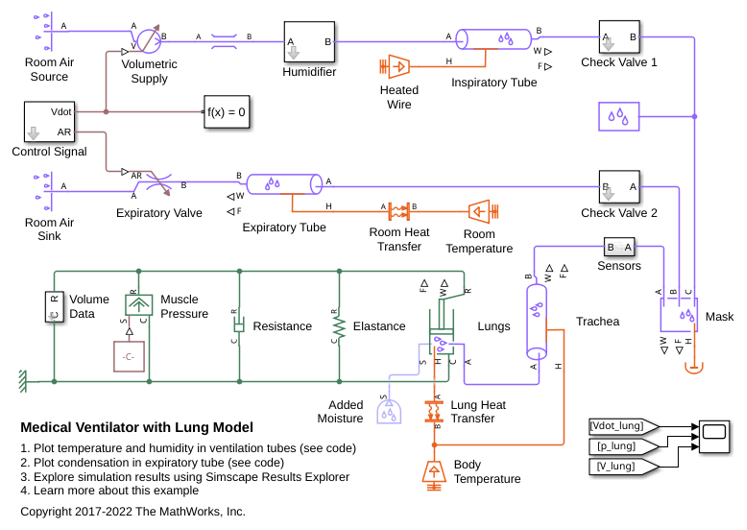
Medical Ventilator with Lung Model
Models a positive-pressure medical ventilator system. A preset flow rate is supplied to the patient. The lungs are modeled with the Translational Mechanical Converter (MA), which converts moist air pressure into translational motion. By setting the Interface cross-sectional area to unity, displacement in the mechanical translational network becomes a proxy for volume, force becomes a proxy for pressure, spring constant becomes a proxy for respiratory elastance, and damping coefficient becomes a proxy for respiratory resistance.
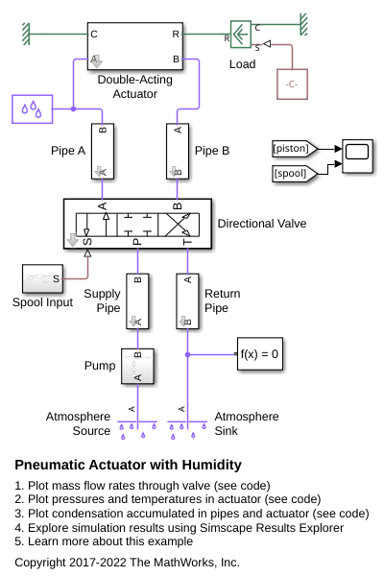
Pneumatic Actuator with Humidity
How the Simscape™ Foundation Library moist air components can be used to model a pneumatic actuator operating in a humid environment. The Directional Valve is a subsystem composed of four Variable Local Restriction (MA) blocks, and the Double-Acting Actuator is a subsystem composed of two Translational Mechanical Converter (MA) blocks in opposite mechanical orientation.

