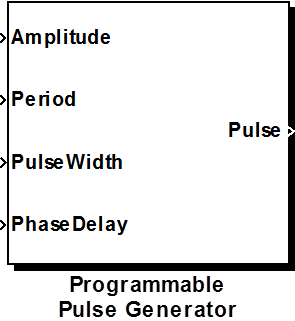
Programmable Pulse Generator using Simulink's basic blocks
The proposed Pulse Generator offers full tunability of its parameters on runtime.

Ahora está siguiendo esta publicación
- Verá actualizaciones en las notificaciones de contenido en seguimiento.
- Podrá recibir correos electrónicos, en función de las preferencias de comunicación que haya establecido.
Citar como
Syed Kazmi (2026). Programmable Pulse Generator using Simulink's basic blocks (https://la.mathworks.com/matlabcentral/fileexchange/35922-programmable-pulse-generator-using-simulink-s-basic-blocks), MATLAB Central File Exchange. Recuperado .
Información general
- Versión (11,1 KB)
Compatibilidad con la versión de MATLAB
- Compatible con cualquier versión
Compatibilidad con las plataformas
- Windows
- macOS
- Linux
| Versión | Publicado | Notas de la versión | Action |
|---|---|---|---|
| 1.0.0 |

