dsp.NCO
R2026bGenerate real or complex sinusoidal signals
Description
The numerically controlled oscillator, or NCO object
generates real or complex sinusoidal signals. The amplitude of the generated signal is always
1.
To generate real or complex sinusoidal signals:
Create the
dsp.NCOobject and set its properties.Call the object with arguments, as if it were a function.
To learn more about how System objects work, see What Are System Objects?
Creation
Description
nco = dsp.NCONCO
System object™, nco, that generates a multichannel real or complex
sinusoidal signal, with independent frequency and phase in each output channel.
nco = dsp.NCO(
returns an PropertyName=Value)NCO
System object, nco, with each
specified property set to the specified value. For example, to specify
the phase increment as 70, set PhaseIncrement to
70.
Properties
Usage
Syntax
Description
Y = nco()PhaseIncrementSource
and the PhaseOffsetSource properties are both set
to "Property".
Y = nco(phInc,OFFSET)Y, with phase
increment, phInc, and phase offset,
OFFSET, when the
PhaseIncrementSource and the
PhaseOffsetSource properties are both
"Input
            port"
. phInc and
OFFSET must both be row vectors of the same
length, where the length determines the number of channels in the
output signal.
Input Arguments
Output Arguments
Object Functions
To use an object function, specify the
System object as the first input argument. For
example, to release system resources of a System object named obj, use
this syntax:
release(obj)
Examples
Design an NCO source according to given specifications.
df = 0.05; % Frequency resolution = 0.05 Hz
minSFDR = 96; % Spurious free dynamic range >= 96 dB
Ts = 1/8000; % Sample period = 1/8000 sec
dphi = pi/2; % Desired phase offset = pi/2;
Calculate number of accumulator bits required for the given frequency resolution.
Nacc = ceil(log2(1/(df*Ts)));
Actual frequency resolution achieved.
actdf = 1/(Ts*2^Nacc);
Calculate number of quantized accumulator bits required from the SFDR requirement
Nqacc = ceil((minSFDR-12)/6);
Calculate the phase offset
phOffset = 2^Nacc*dphi/(2*pi);
Design the NCO source.
nco = dsp.NCO(PhaseOffset=phOffset,...
    NumDitherBits=4, ...
    NumQuantizerAccumulatorBits=Nqacc,...
    SamplesPerFrame=1/Ts, ...
    CustomAccumulatorDataType=numerictype([],Nacc));
san = spectrumAnalyzer(SampleRate=1/Ts,...
    Method="welch",AveragingMethod="exponential",...
    ForgettingFactor=0.3,...
    PlotAsTwoSidedSpectrum=false);
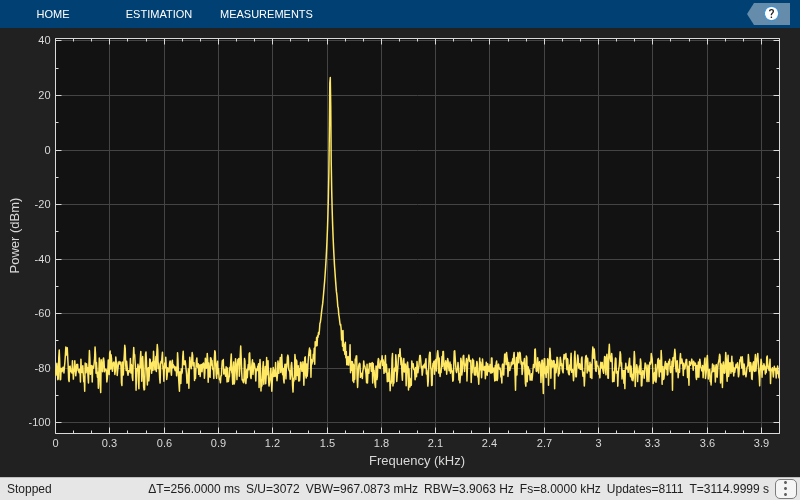
View the output of the NCO source on a spectrum analyzer. Change the output frequency in the middle of the simulation from 510 Hz to 1520 Hz.
tic;
while toc < 10

    if toc < 5
        F0 = 510;
    else
        F0 = 1520;
    end
    % Calculate the phase increment
    phIncr = int32(round(F0*Ts*2^Nacc));
    y = nco(phIncr);
    san(y)
end
release(san)
The characteristic information of the NCO object is defined by the following fields:
NumPointsLUT— Number of data points in the lookup table.SineLUTSize— Quarter-wave sine lookup table size in bytes.TheoreticalSFDR— Theoretical spurious free dynamic range (SFDR) in dBc.FrequencyResolution— Frequency resolution of theNCO.
To obtain the above characteristics for a specific NCO object, call the info function on the object.
nco = dsp.NCO
nco =
  dsp.NCO with properties:

                PhaseIncrementSource: 'Input port'
                   PhaseOffsetSource: 'Property'
                         PhaseOffset: 0
                              Dither: true
                       NumDitherBits: 4
                   PhaseQuantization: true
         NumQuantizerAccumulatorBits: 12
    PhaseQuantizationErrorOutputPort: false
                            Waveform: 'Sine'
                     SamplesPerFrame: 1
                      OutputDataType: 'Custom'

  Show all properties
info(nco)
ans = struct with fields:
           NumPointsLUT: 1025
            SineLUTSize: 2050
        TheoreticalSFDR: 84
    FrequencyResolution: 1.5259e-05
The fields and their corresponding values change depending on the settings of the object. For instance, if the PhaseQuantization property is set to false, the TheoreticalSFDR field does not appear.
nco.PhaseQuantization = false;
info(nco)
ans = struct with fields:
           NumPointsLUT: 16385
            SineLUTSize: 32770
    FrequencyResolution: 1.5259e-05
Algorithms
This object implements the algorithm, inputs, and outputs described on the NCO block reference page. The object properties correspond to the block properties, except there is no object property that corresponds to the Sample time block parameter. The objects assumes a sample time of one second.
Extended Capabilities
Version History
Introduced in R2012a

