Identify Refrigeration Cycle Operating Points
R2026bThis example shows how to define and plot the four operating points of a vapor-compression refrigeration cycle on a P-h diagram. The model calculates the thermodynamic state at each operating point for the specified cycle conditions and computes the cycle performance metrics, including the coefficient of performance (COP) and pressure ratio. To understand the operating points of your own refrigeration system, replace the values in this model with the conditions for your system.
Examine the Model
Open the IdentifyRefrigerationCycleOperatingPoints model.
open_system("IdentifyRefrigerationCycleOperatingPoints")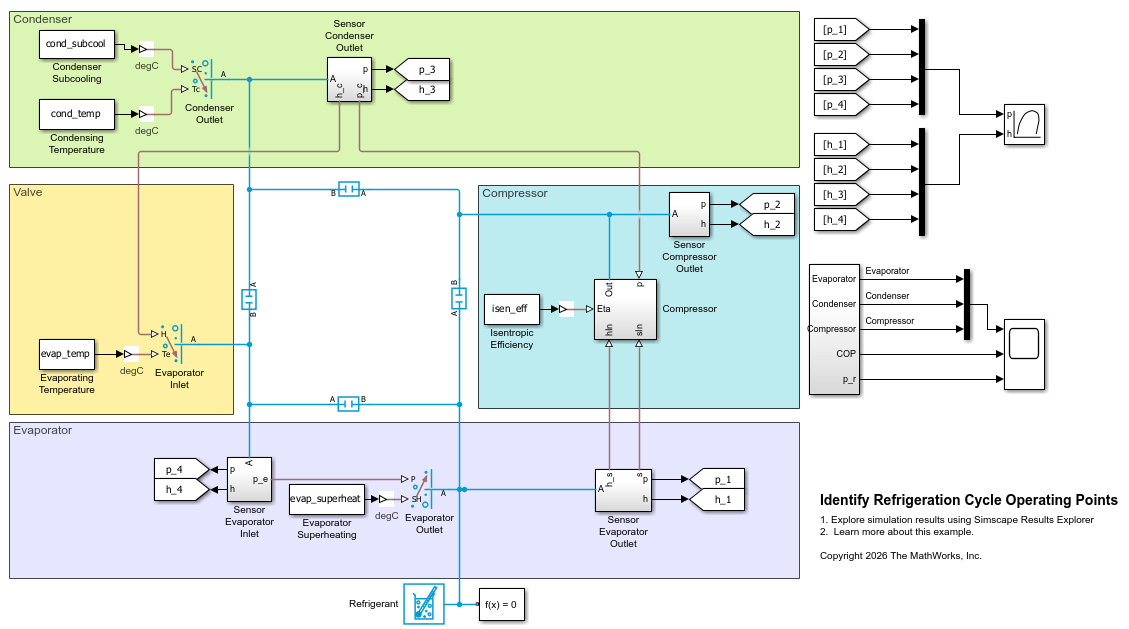
This is a model that approximates the conditions at the four points of the refrigeration cycle by using Reservoir (2P) blocks. The model contains four colored area annotations:
Condenser — Contains the
Condenser OutletReservoir (2P) block. This reservoir sets its pressure from the condensing temperature and its energy state from the condenser subcooling.Valve — Contains the
Evaporator InletReservoir (2P) block. This reservoir sets its pressure from the evaporating temperature and its energy state from the enthalpy at the condenser outlet.Evaporator — Contains the
Evaporator OutletReservoir (2P) block. This reservoir sets its pressure from theEvaporator Inletreservoir and its energy state from the evaporator superheating.Compressor — Contains the
Compressorsubsystem, which calculates the compressor discharge state using the isentropic efficiency.
Compressor Subsystem
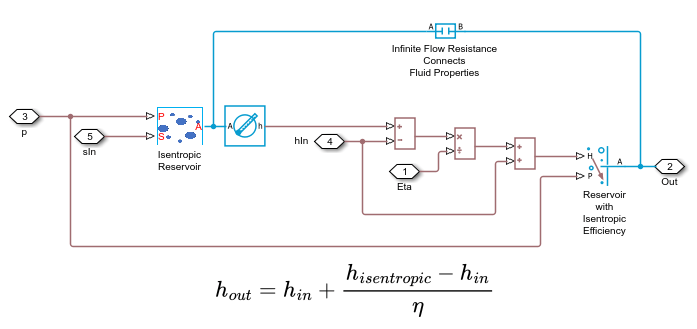
The Compressor subsystem calculates the added enthalpy from the work the compressor performs on the fluid from the specified isentropic efficiency by using the equation . To approximate , the specific enthalpy of the fluid at the compressor inlet, the model uses a custom Simscape block. Unlike the Reservoir (2P) block, which requires you to specify the pressure and temperature or the pressure and enthalpy, the Isentropic Reservoir custom block calculates the fluid state from the pressure and specific entropy, which you specify at ports P and S.
In this model, the Isentropic Reservoir block defines fluid conditions that have the same outlet pressure as the condenser and the same specific entropy as the evaporator outlet.
Define Operating Conditions
This example uses the same operating conditions as the Refrigeration Cycle (Air Conditioning) and Model a Refrigeration Cycle examples. To plot the P-h diagram, specify the condensing temperature, evaporating temperature, condenser subcooling, evaporator superheating, and compressor isentropic efficiency for the system.
Define the operating points and open the model.
cond_subcool = 5;       % [degC] Condenser subcooling temperature
cond_temp = 45;         % [degC] Condensing temperature
evap_superheat = 5;     % [degC] Evaporator superheating temperature
evap_temp = 5;          % [degC] Evaporator superheating temperature
isen_eff = 0.7;         % Compressor isentropic efficiency
In the Two-Phase Fluid Predefined Properties block, Refrigerant, update the working fluid to specify the system refrigerant. Because the P-H Diagram (2P) block in this model already connects to the Two-Phase Fluid Predefined Properties block, you do not need to update this block.
set_param("IdentifyRefrigerationCycleOperatingPoints/Refrigerant",fluid="fluids.two_phase_fluid.utilities.enum.Fluid.R410A")
Simulate Model and Examine Results
Run the model and examine the results.
open_system("IdentifyRefrigerationCycleOperatingPoints/Scope")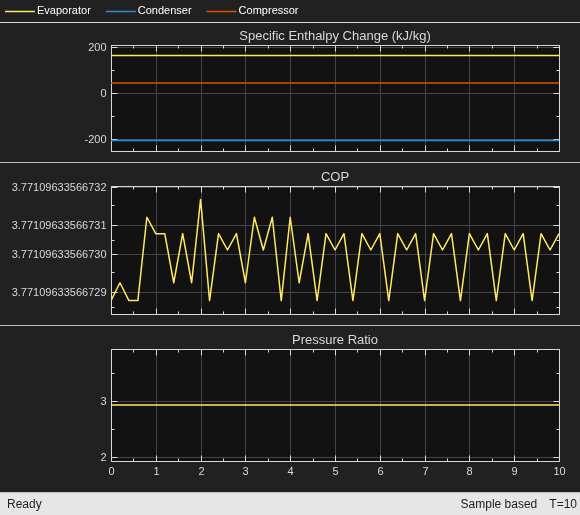
sim("IdentifyRefrigerationCycleOperatingPoints");The Scope block shows the evaporator, condenser, and compressor specific enthalpy; the COP; and the pressure ratio across the compressor.
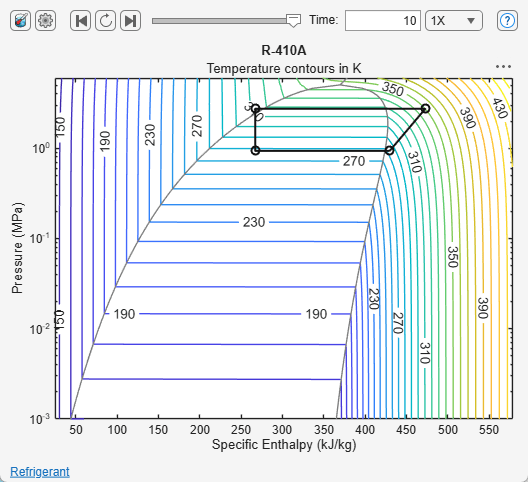
Open the P-H Diagram (2P) block. The P-H Diagram block plots the four operating points on a pressure-enthalpy chart with the refrigerant saturation dome. You can use this plot to understand the cycle behavior and see how changes to the inputs affect the cycle. For example, increasing the condensing temperature raises the high-side pressure line upward, which increases the compressor work and decreases the COP.