Refrigeration
R2026bIn this section, you can find examples and resources on refrigeration.
Functions
refrigerantChargeProperties | Calculate two-phase fluid states based on charge density and temperature (Since R2026a) |
Simscape Blocks
 | System-Level Refrigeration Cycle (2P) | System-level, two-phase refrigeration block in a gas, moist air, thermal liquid, or two-phase fluid network (Since R2023a) |
Featured Examples
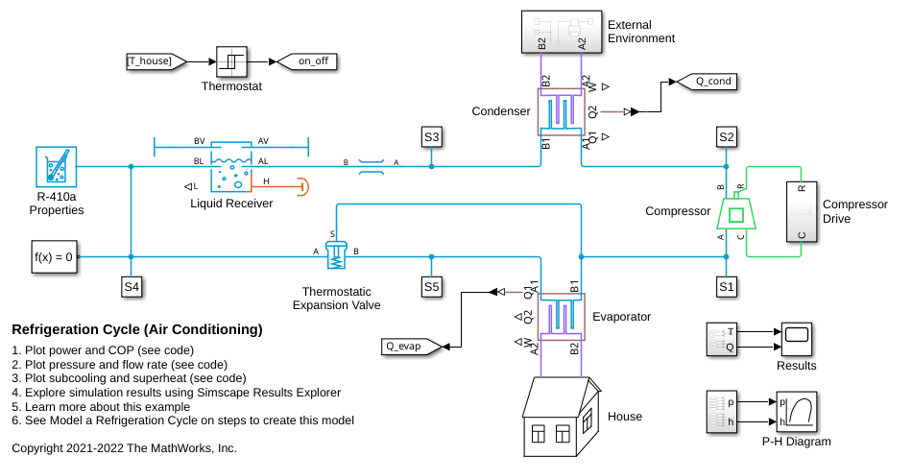
Refrigeration Cycle (Air Conditioning)
A refrigeration cycle for a home air conditioning system. See Model a Refrigeration Cycle for the recommended steps to build this model in the two-phase fluid domain.
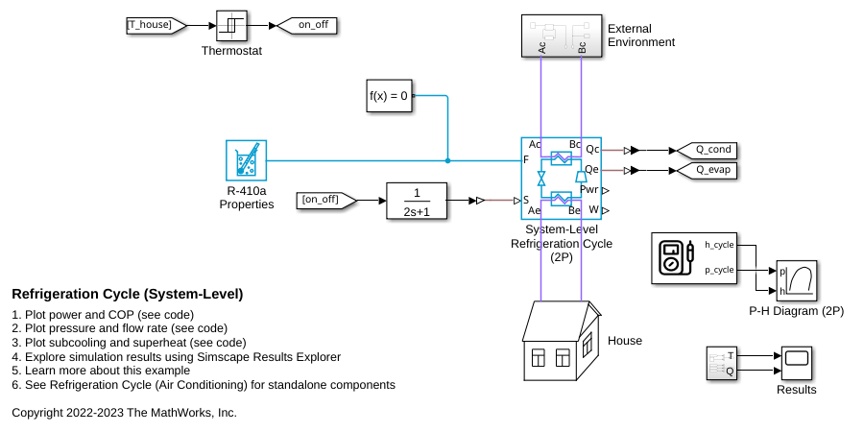
Refrigeration Cycle (System-Level)
Model a refrigeration cycle for a home air conditioning system at an abstract system level using the System-Level Refrigeration Cycle (2P) block. This block simplifies the set up of the refrigeration cycle by encapsulating the entire refrigerant loop in one block.
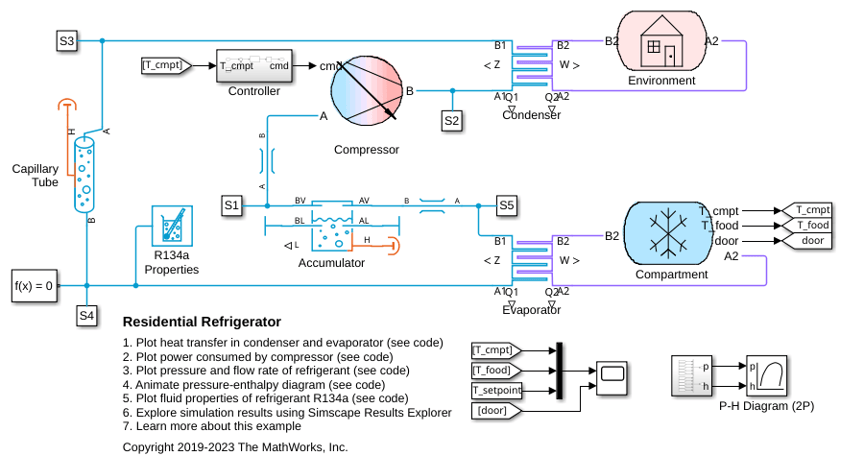
Residential Refrigerator
Models a basic refrigeration system that transfers heat between the refrigerant two-phase fluid and the environment moist air mixture. The compressor drives the R134a refrigerant through a condenser, a capillary tube, and an evaporator. An accumulator ensures that only vapor returns to the compressor.
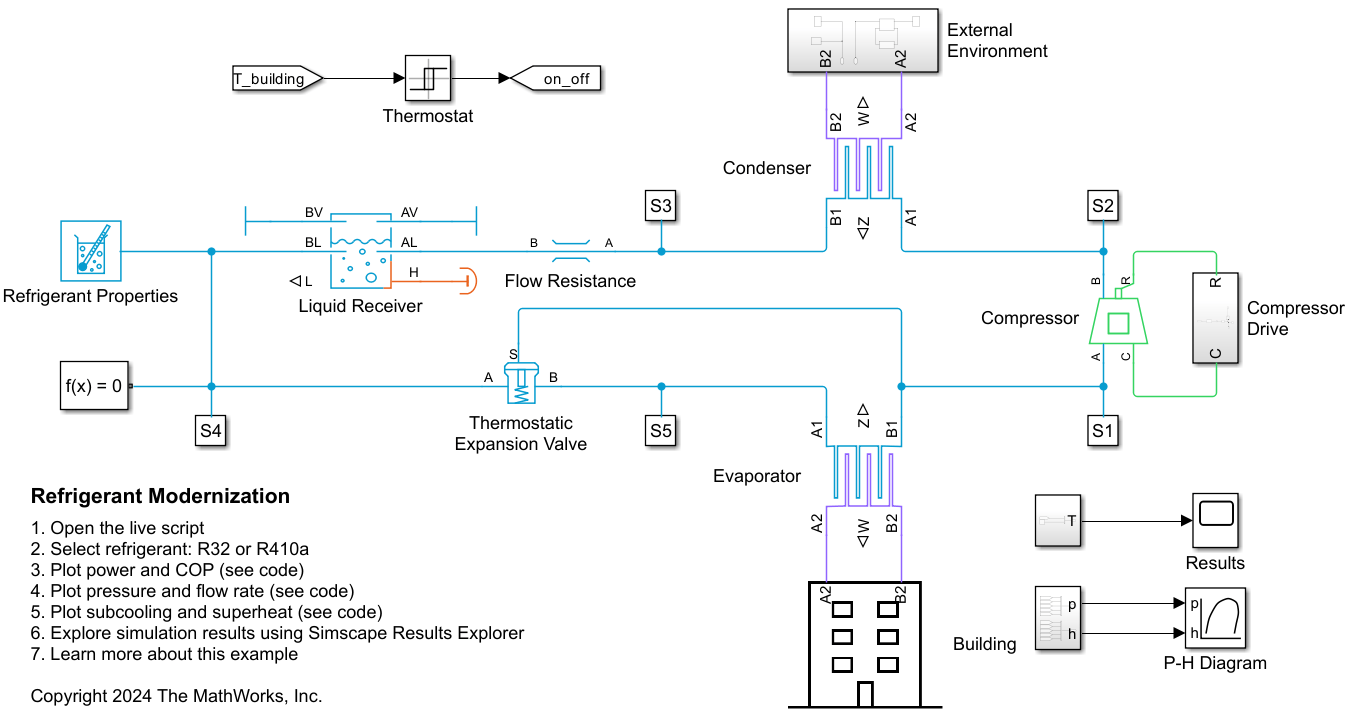
Refrigerant Modernization
Retrofit a Simscape™ cooling cycle that uses R410a to utilize R32, which is a refrigerant with a lower Global Warming Potential (GWP). The process involves modifying the nominal mass flow rate and refrigerant charge, while retaining the original evaporator and condenser specifications. For more information on designing a cooling cycle, see Model a Refrigeration Cycle and Refrigeration Cycle (Air Conditioning).
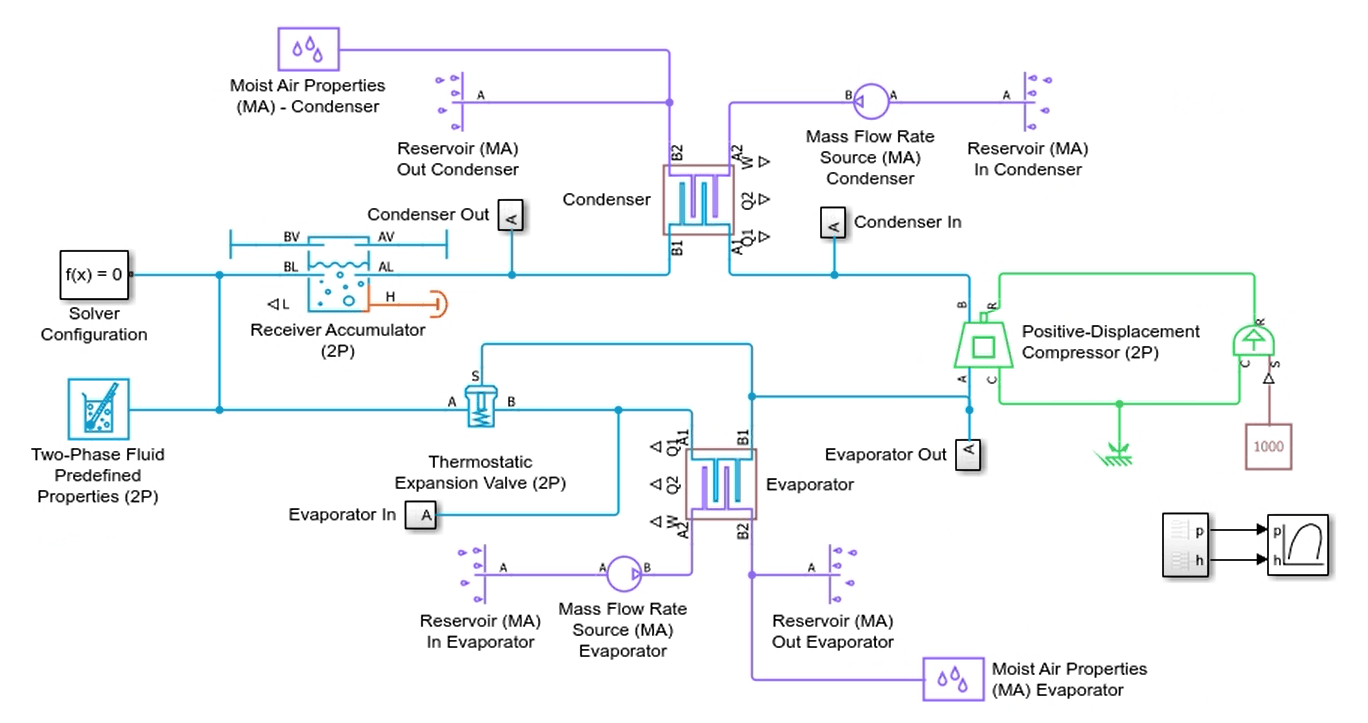
Model a Refrigeration Cycle
Explains how to model a closed-loop refrigeration cycle. Simulating a refrigeration cycle requires you to properly tune the component parameters. Imbalances in the net energy transfer can cause runaway system pressure and temperature. Because the refrigerant undergoes energy transfer that causes substantial and rapid density changes, you start by modeling and verifying the response of the individual components. You integrate the components into an open-loop system, and then close the loop.
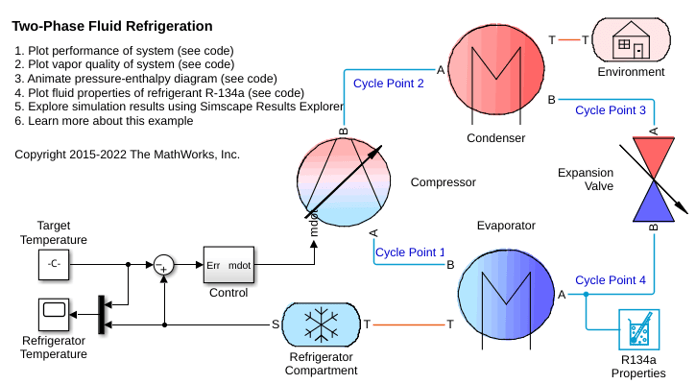
Two-Phase Fluid Refrigeration
Models a vapor-compression refrigeration cycle using two-phase fluid components. The compressor drives the R-134a refrigerant through a condenser, an expansion valve, and an evaporator. The hot gas leaving the compressor condenses in the condenser via heat transfer to the environment. The pressure drops as the refrigerant passes through the expansion valve. The drop in pressure lowers the saturation temperature of the refrigerant. This enables it to boil in the evaporator as it absorbs heat from the refrigerator compartment. The refrigerant then returns to the compressor to repeat the cycle. The controller turns the compressor on and off to maintain the refrigerator compartment temperature within a band around the desired temperature.
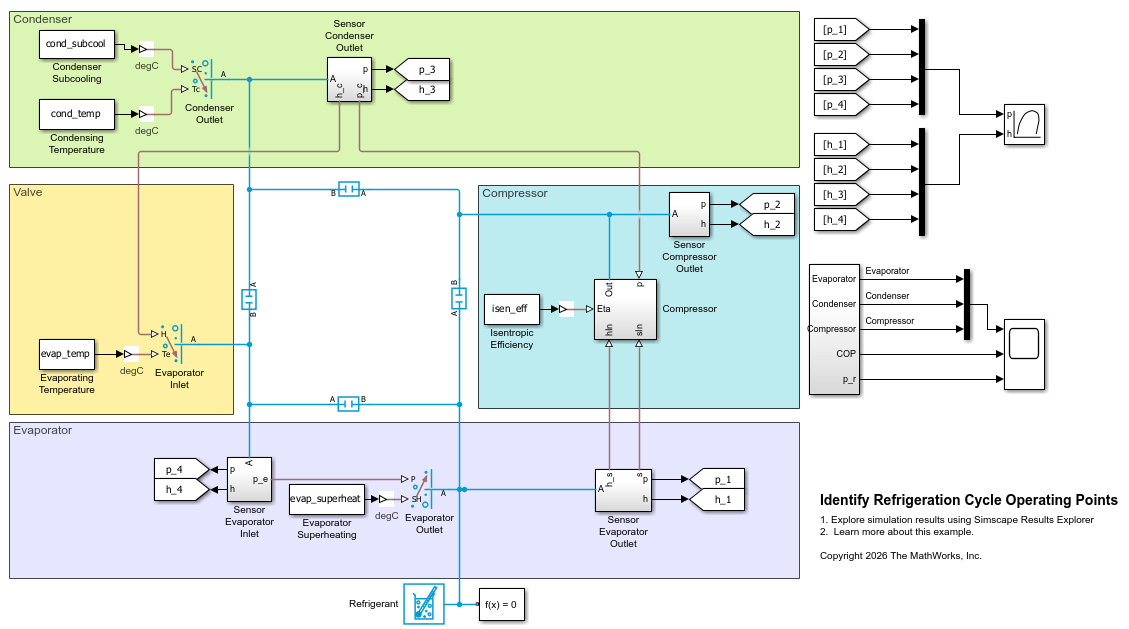
Identify Refrigeration Cycle Operating Points
Define and plot the four operating points of a vapor-compression refrigeration cycle on a P-h diagram. The model calculates the thermodynamic state at each operating point for the specified cycle conditions and computes the cycle performance metrics, including the coefficient of performance (COP) and pressure ratio. To understand the operating points of your own refrigeration system, replace the values in this model with the conditions for your system.
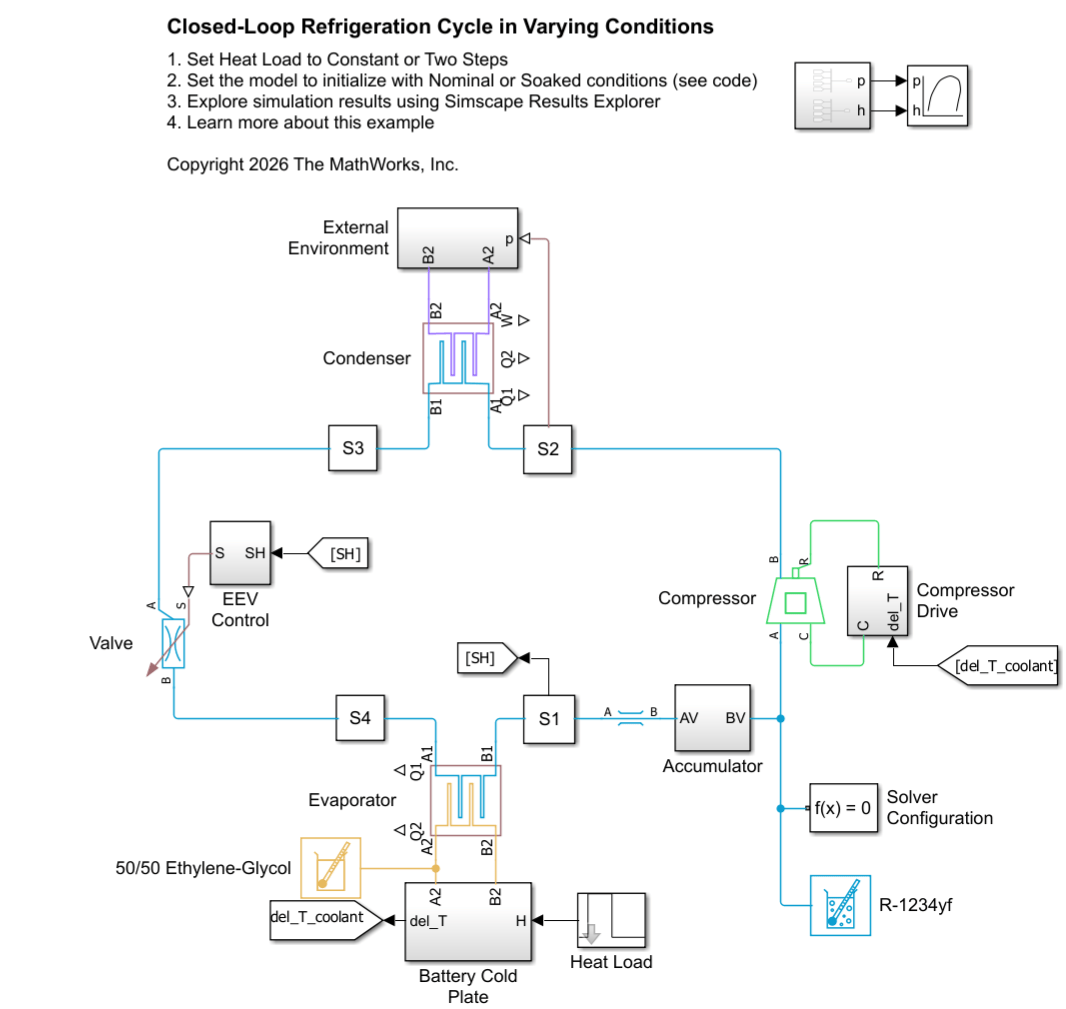
Troubleshoot a Refrigeration Cycle
Demonstrates potential modeling errors in a closed-loop two-phase refrigeration system and shows how to diagnose and fix them. The example covers each error by injecting a mistake, observing the symptoms, identifying the root cause, and applying the fix.
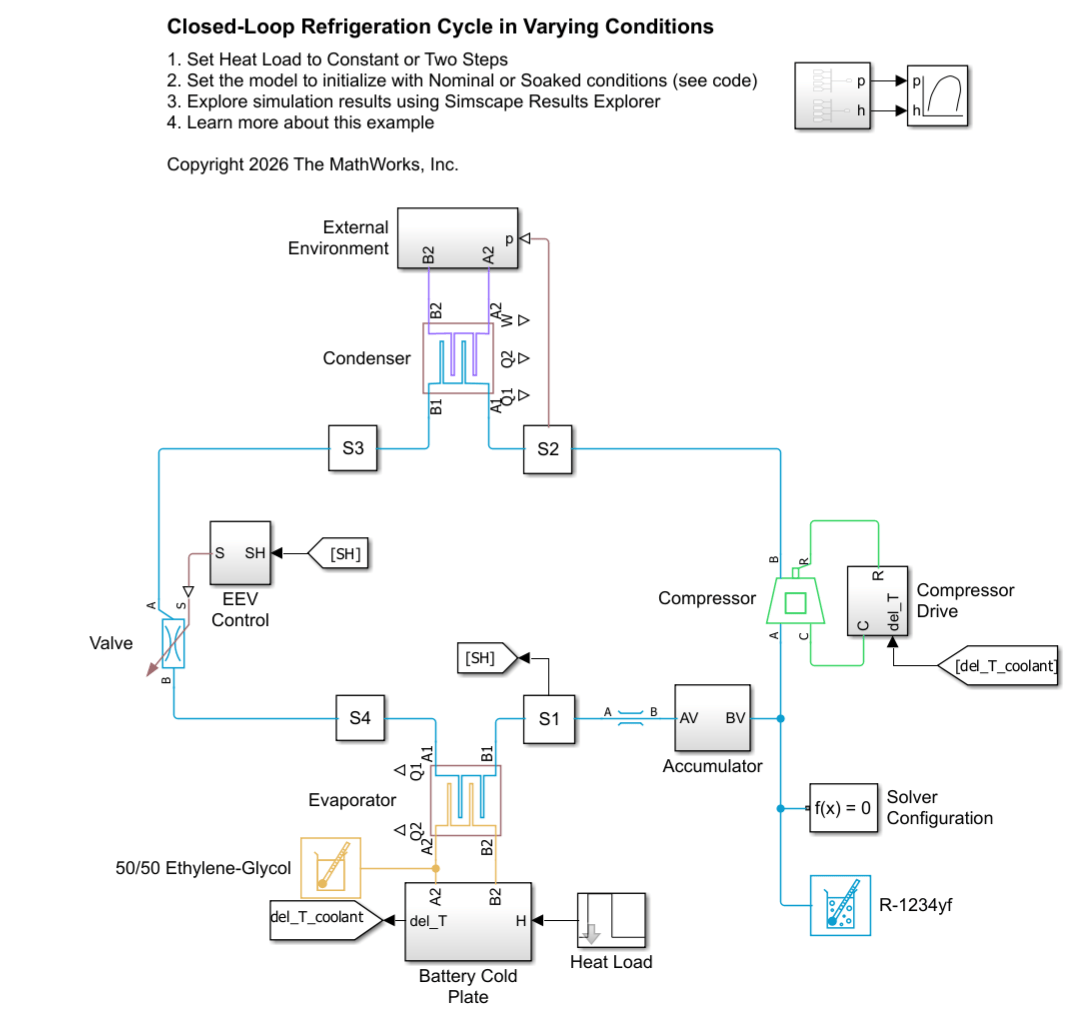
Model a Refrigeration Cycle with Varying Conditions
Extends the Model a Refrigeration Cycle workflow. That workflow develops a refrigeration system that initializes and operates at a nominal operating state. In that example, you choose pressure and enthalpy operating points and load and environment conditions, build open-loop test harnesses, and then close the refrigeration loop.

