freqoctspace
R2026bDescription
F = freqoctspace(___,Name=Value)
Examples
Generate a vector with mid-band frequencies for octave bands between 100 and 10000 Hz.
Fm1 = freqoctspace(100,10000,1)
Fm1 = 1×7
103 ×

    0.1259    0.2512    0.5012    1.0000    1.9953    3.9811    7.9433
Generate a vector with mid-band frequencies for octave subbands between 500 and 2000 Hz. Use 3 subbands per octave and an octave ratio base of 2.
Fm3 = freqoctspace(500,2000,3,OctaveRatioBase=2)
Fm3 = 1×7
103 ×

    0.5000    0.6300    0.7937    1.0000    1.2599    1.5874    2.0000
Create a signal comprising sinusoidal tones, where each tone spans one second.
Fs = 5e3;
N = length(Fm3);
t = 0:1/Fs:N-1/Fs;
x = sum(sin(2*pi*(Fm3'*t).*((t>=(0:N-1)').*(t<(1:N)'))),1);
spectrogram(x,256,192,1024,Fs,"yaxis")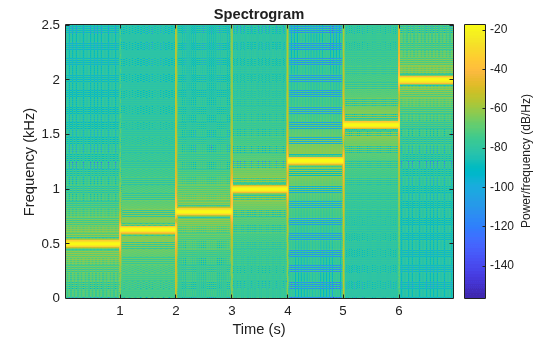
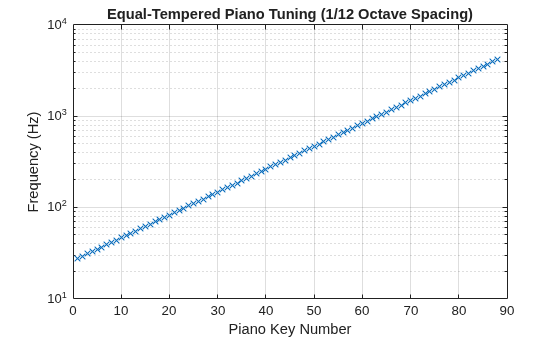
Generate a vector of frequencies spaced by 1/12 octave (equal temperament), starting from the note A0 (27.5 Hz) to the note C8 (4186 Hz), which covers the frequency range of a standard 88-key piano. Specify start and end frequencies just beyond A0 and C8 to ensure that they are covered by the band edge frequencies.
[Fm88,Fe88] = freqoctspace(27,4187,12, ...
    OctaveRatioBase=2,ReferenceFrequency=440*2^(0.5/12));
Plot the mid-band frequencies for the generated frequency space.
semilogy(Fm88,"x")
xlabel("Piano Key Number")
ylabel("Frequency (Hz)")
title("Equal-Tempered Piano Tuning (1/12 Octave Spacing)")
grid on
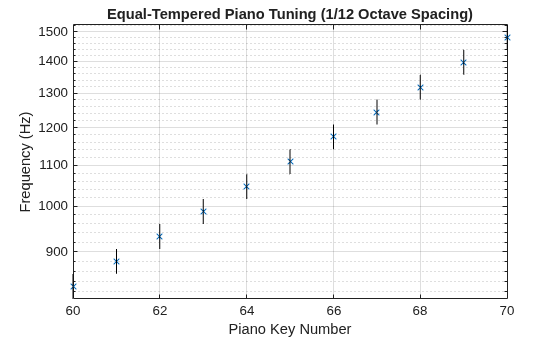
Add the band edge frequencies for the generated frequency space and zoom in the plot for the piano keys 60 through 70.
hold on
semilogy(repmat(1:length(Fm88),2,1),Fe88,"k")
hold off
xlim([60 70])
Input Arguments
Name-Value Arguments
Output Arguments
Algorithms
Octave analysis is used to identify sound or vibration levels
across a broad frequency range in a process that resembles how a human ear perceives sound.
The freqoctspace function generates a vector that represents frequencies
logarithmically distributed that form octaves, which you can use to perform octave
analysis.
Assume a reference frequency fr, an octave ratio G, and a distribution of b subbands per octave. The ANSI/ASA S1.11-2014/Part 1 / IEC 61260:1-2014 standard [1] defines the center frequencies of the octave bands, fc, as
where k is any integer and represents the band number above or below the reference frequency. Given a frequency range [fmin, fmax], the function trims fc so that fmin ≤ fc ≤ fmax.
The center frequency definition differs depending on whether b is odd (for instance, for bandwidths of 1 octave or 1/3 octave), or even (for instance, for bandwidths of 1/2 octave or 1/6 octave). This definition ensures that the band edges of the whole octave band remain band edges for all of the fractional bands.
The lower and upper edge frequencies of each octave band are given by
References
[1] Electroacoustics – Octave-band and Fractional-octave-band Filters – Part 1: Specifications (a nationally adopted international standard). ANSI/ASA S1.11-2014/Part 1 / IEC 61260:1-2014. Melville, NY: Acoustical Society of America, 2014.
Extended Capabilities
Version History
Introduced in R2026b

