symaux
R2026b(To be removed) Symlet wavelet filter computation
symaux will be removed in a future release. Use daubfactors
instead. (since R2026a) For more information, see Version History.
Description
The symaux function generates the scaling filter coefficients
for the "least asymmetric" Daubechies wavelets.
w = symaux(n)n Symlet scaling filter such that sum(w) =
1.
Note
Instability may occur when
nis too large. Starting with values ofnin the 30s range, function output will no longer accurately represent scaling filter coefficients.As
nincreases, the time required to compute the filter coefficients rapidly grows.For
n= 1, 2, and 3, the ordernSymlet filters and ordernDaubechies filters are identical. See Extremal Phase Wavelet.
Examples
In this example you will generate symlet scaling filter coefficients whose norm is equal to 1. You will also confirm the coefficients satisfy a necessary relation.
Compute the scaling filter coefficients of the order 10 symlet whose sum equals.
n = 10;
w = symaux(n,sqrt(2));
Confirm the sum of the coefficients is equal to and the norm is equal to 1.
sqrt(2)-sum(w)
ans =
0
1-sum(w.^2)
ans =
1.1324e-14
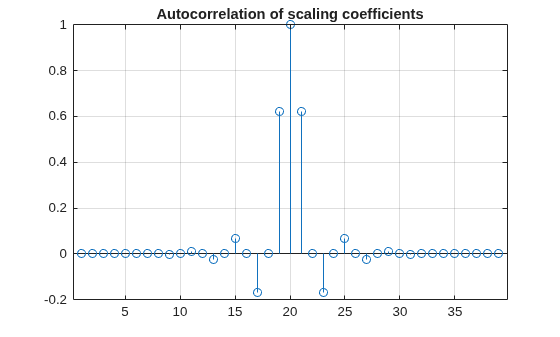
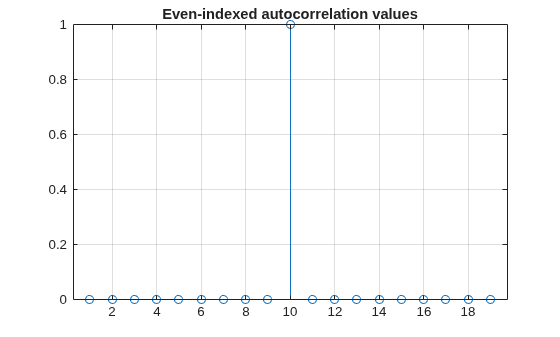
Since integer translations of the scaling function form an orthogonal basis, the coefficients satisfy the relation . Confirm this by taking the autocorrelation of the coefficients and plotting the result.
corrw = xcorr(w,w);
stem(corrw)
grid on
title('Autocorrelation of scaling coefficients')
stem(corrw(2:2:end))
grid on
title('Even-indexed autocorrelation values')
This example shows that symlet and Daubechies scaling filters of the same order are both solutions of the same polynomial equation.
Generate the order 4 Daubechies scaling filter and plot it.
wdb4 = dbaux(4);
stem(wdb4)
title('Order 4 Daubechies Scaling Filter')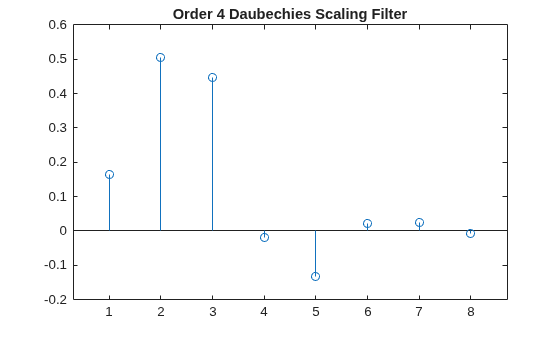
wdb4 is a solution of the equation: P = conv(wrev(w),w)*2, where P is the "Lagrange trous" filter for N = 4. Evaluate P and plot it. P is a symmetric filter and wdb4 is a minimum phase solution of the previous equation based on the roots of P.
P = conv(wrev(wdb4),wdb4)*2;
stem(P)
title('''Lagrange trous'' filter')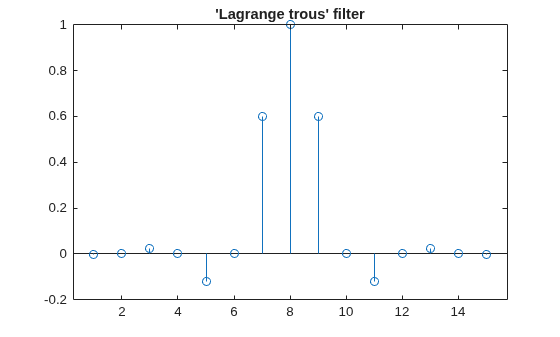
Generate wsym4, the order 4 symlet scaling filter and plot it. The Symlets are the "least asymmetric" Daubechies' wavelets obtained from another choice between the roots of P.
wsym4 = symaux(4);
stem(wsym4)
title('Order 4 Symlet Scaling Filter')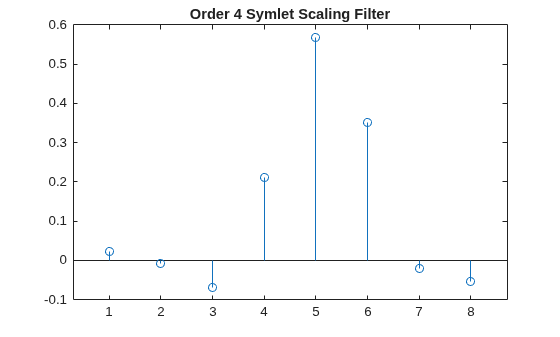
Compute conv(wrev(wsym4),wsym4)*2 and confirm that wsym4 is another solution of the equation P = conv(wrev(w),w)*2.
P_sym = conv(wrev(wsym4),wsym4)*2;
err = norm(P_sym-P)
err =
1.2491e-15
Input Arguments
Output Arguments
More About
References
[1] Daubechies, I. Ten Lectures on Wavelets, CBMS-NSF Regional Conference Series in Applied Mathematics. Philadelphia, PA: SIAM Ed, 1992.
[2] Oppenheim, Alan V., and Ronald W. Schafer. Discrete-Time Signal Processing. Englewood Cliffs, NJ: Prentice Hall, 1989.

