fnoNetwork
R2026bDescription
net = fnoNetwork(inputSize,outputSize)
net = fnoNetwork(inputSize,outputSize,Name=Value)Dimension=1 creates a 1-D FNO network.
Examples
Create a 2-D Fourier neural operator (FNO) network with three input channels and one output channel.
inputSize = 3;
outputSize = 1;

net = fnoNetwork(inputSize,outputSize)
net =
  dlnetwork with properties:

         Layers: [4×1 nnet.cnn.layer.Layer]
    Connections: [3×2 table]
     Learnables: [20×3 table]
          State: [0×3 table]
     InputNames: {'input'}
    OutputNames: {'projection'}
    Initialized: 1

  View summary with summary.
Visualize the network in a plot.
figure
tiledlayout("flow")

nexttile
plot(net)
axis off
title("2-D Fourier Neural Operator")

nexttile
plot(net.Layers(2).Network)
axis off
title("Lift Subnetwork")

nexttile
plot(net.Layers(3).Network)
axis off
title("Fourier Layers")

nexttile
plot(net.Layers(4).Network)
axis off
title("Projection Subnetwork")
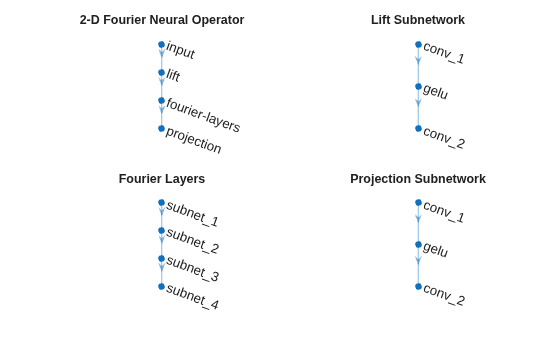
The network has three components: the lift subnetwork, the Fourier layers, and the projection subnetwork.
The lift network has two linear layers, represented as convolution layers with a filter size of 1, with a GELU activation between them.
There are four subnetworks that represent the four Fourier layers.
The projection subnetwork contains two linear layers, represented as convolution layers with a filter size of 1, with a GELU activation between them.
Input Arguments
Name-Value Arguments
Output Arguments
More About
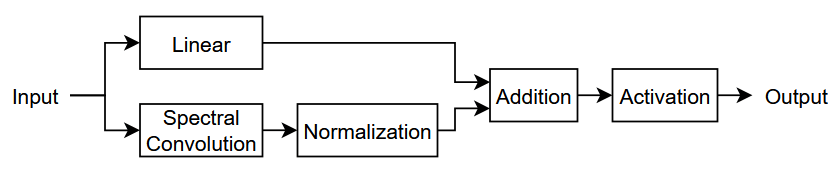
A Fourier layer is a network with two parallel paths that branch from the input:
Spectral convolution path — The input passes through a spectral convolution layer, which transforms the data to the frequency domain, applies a learned linear transformation to a fixed number of Fourier modes, and transforms the result back to the spatial domain. The layer applies an optional normalization operation to the output of the spectral convolution layer.
Skip connection path — The input passes through a linear layer, represented as a convolution layer with a filter size of 1. This path allows information to bypass the spectral convolution and helps stabilize training.
The layer combines both outputs using an addition layer. Optionally, the layer can apply an activation before or after the addition operation.
This diagram shows the structure of a Fourier layer that applies the activation after the addition operation.
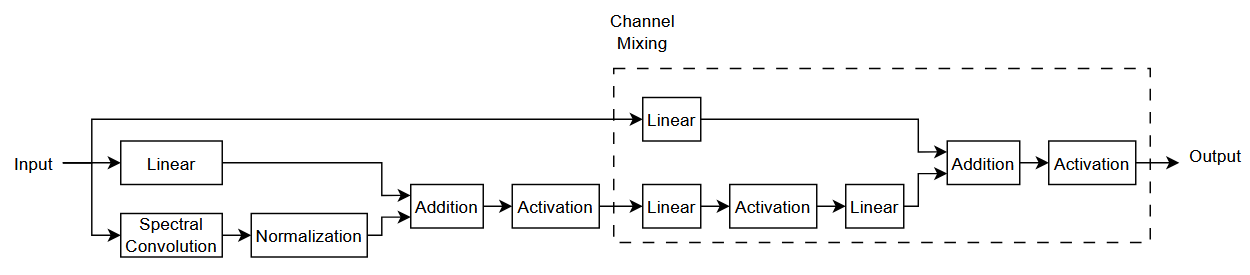
The layer can also include channel mixing by appending a channel mixing block after the spectral convolution addition. The channel mixing block has two parallel paths:
MLP path — The output of the spectral convolution addition passes through an activation and then two linear layers (represented as convolution layers with a filter size of 1) with an activation between them.
MLP skip connection path — The original Fourier layer input passes through a linear layer, represented as a convolution layer with a filter size of 1. This path bypasses both the spectral convolution block and the MLP.
The layer combines the MLP path and the MLP skip connection path using an addition layer and then applies an activation function.
This diagram shows the structure of a Fourier layer with channel mixing that applies the activation after the addition operation.
A Fourier neural operator (FNO) network learns mappings between function spaces using spectral convolution layers, which perform learned transformations in the frequency domain.
FNOs are particularly effective for learning solution operators of parametric partial differential equations (PDEs), where the goal is to learn a mapping from input functions (such as initial conditions, boundary conditions, or PDE coefficients) to output functions (such as the PDE solution) [1].
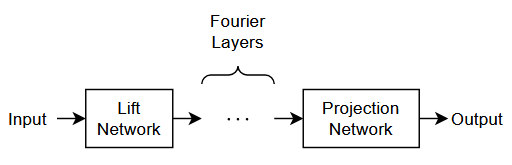
The FNO architecture consists of three main components:
Lift Network — The lift network maps the input channels to a higher-dimensional latent space. It consists of two linear layers, represented as convolution layers with a filter size of 1, with an activation function in between.
Fourier Layers — The core of the FNO architecture is a sequence of Fourier layers. Each Fourier layer has two parallel paths: a spectral convolution path that operates in the frequency domain by retaining a fixed number of Fourier modes, and a linear skip connection path. The layer combines the outputs of both paths using addition and optionally applies an activation function.
Projection Network — The projection network maps from the latent space back to the output channel space. Like the lift network, it consists of two linear layers, represented as convolution layers with a filter size of 1, with an activation function in between.
This diagram shows the architecture of an FNO network.
References
[1] Li, Zongyi, Nikola Kovachki, Kamyar Azizzadenesheli, Burigede Liu, Kaushik Bhattacharya, Andrew Stuart, and Anima Anandkumar. "Fourier Neural Operator for Parametric Partial Differential Equations." arXiv, May 17, 2021. https://doi.org/10.48550/arXiv.2010.08895.
Version History
Introduced in R2026b
See Also
spectralConvolution1dLayer | spectralConvolution2dLayer | spectralConvolution3dLayer | neuralODELayer | transolverNetwork | resnetNetwork | trainnet | trainingOptions | dlnetwork
Topics
- Solve PDE Using Fourier Neural Operator
- Solve PDE Using Physics-Informed Neural Network
- 3-D Battery Module Cooling Analysis Using Fourier Neural Operator (Partial Differential Equation Toolbox)

