Automatic Differentiation Background
R2026bWhat Is Automatic Differentiation?
Automatic differentiation (also known as autodiff, AD, or algorithmic differentiation) is a set of techniques for numerically evaluating derivatives (such as gradients and Jacobians) of a mathematical function. The method uses symbolic rules for differentiation, which are more accurate than finite difference approximations. Unlike a purely symbolic approach that performs large symbolic computations, automatic differentiation numerically evaluates expressions early in the computations. In other words, automatic differentiation evaluates derivatives at particular numeric values; it does not construct symbolic expressions for derivatives.
Forward mode automatic differentiation evaluates a numerical derivative of a mathematical function by performing elementary derivative operations concurrently with the operations of evaluating the function itself. As detailed in the next section, MATLAB® performs these operations on a computational graph.
Reverse mode automatic differentiation uses an extension of the forward mode computational graph to enable the computation of a gradient by a reverse traversal of the graph. While computing the mathematical function and its derivative, MATLAB records operations in a data structure called a trace.
As many researchers have noted (for example, Baydin, Pearlmutter, Radul, and Siskind [1]), for a scalar function of many variables, reverse mode calculates the gradient more efficiently than forward mode. For further background, see [2].
In MATLAB, you can specify to use automatic differentiation as the calculation
method for some derivatives. For example, for an ode
object that represents a system of equations, you can set its
JacobianMethod property to "autodiff" to
calculate the Jacobians using automatic differentiation.
Forward Mode
Consider the problem of evaluating this function and its gradient:
Automatic differentiation works at particular points. For this example, let x1 = 2 and x2 = 1/2.
This computational graph encodes the calculation of the function f(x).
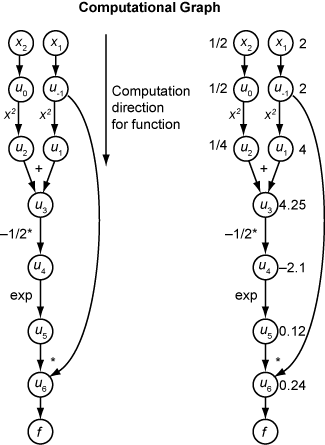
To compute the gradient of f(x) using forward mode, you follow the same graph in the same direction but modify the computation based on the elementary rules of differentiation. To further simplify the calculation, you fill in the value of the derivative of each subexpression ui as you go. To compute the entire gradient, you must traverse the graph twice, once for the partial derivative with respect to each independent variable. Each subexpression in the chain rule has a numeric value, so the entire expression has the same sort of computational graph as the function itself.
The computation is a repeated application of the chain rule. In this example, the derivative of f with respect to x1 expands to this expression:
Let represent the derivative of the expression ui with respect to x1. Using the evaluated values of ui from the function evaluation, you compute the partial derivative of f with respect to x1 as shown in the following figure. Notice that all the values of become available as you traverse the graph from top to bottom.
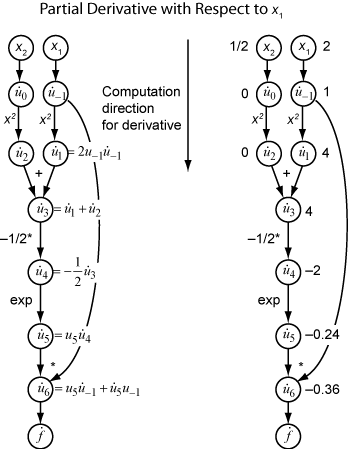
To compute the partial derivative with respect to x2, you traverse a similar computational graph. Therefore, when you compute the gradient of the function, the number of graph traversals is the same as the number of variables. This process can be slow for many applications, when the objective function or nonlinear constraints depend on many variables.
Reverse Mode
Reverse mode uses one forward traversal of a computational graph to set up the trace. Then it computes the entire gradient of the function in one traversal of the graph in the opposite direction. For problems with many variables, this mode is far more efficient.
The theory behind reverse mode is also based on the chain rule, along with associated adjoint variables denoted with an overbar. The adjoint variable for ui is
In terms of the computational graph, each outgoing arrow from a variable contributes to the corresponding adjoint variable by its term in the chain rule. For example, the variable u–1 has outgoing arrows to two variables, u1 and u6. The graph has the associated equation
In this calculation, recalling that and u6 = u5u–1, you obtain
During the forward traversal of the graph, MATLAB calculates the intermediate variables ui. During the reverse traversal, starting from the seed value , the reverse mode computation obtains the adjoint values for all variables. Therefore, reverse mode computes the gradient in just one pass, requiring much less time compared to forward mode.
The following computational graph shows how to compute the gradient in reverse mode for the function
Again, let x1 = 2 and x2 = 1/2. The reverse mode computation relies on the ui values that are obtained during the forward traversal of the original computational graph. On the right side of the figure, the computed values of the adjoint variables appear next to the adjoint variable names, using the formulas from the left side of the figure.
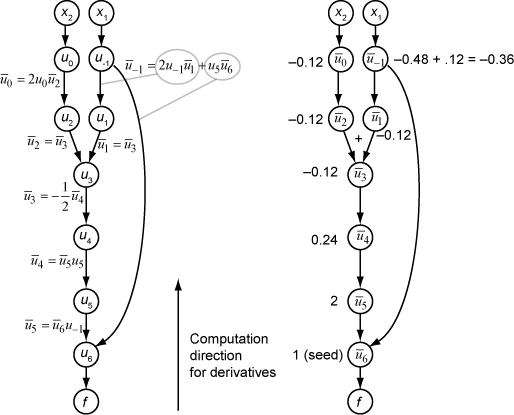
The final gradient values appear as and .
References
[1] Baydin, Atilim Gunes, Barak A. Pearlmutter, Alexey Andreyevich Radul, and Jeffrey Mark Siskind. "Automatic Differentiation in Machine Learning: A Survey." Journal of Machine Learning Research 18, no. 153 (2018): 1–43. https://arxiv.org/abs/1502.05767.
[2] "Automatic differentiation." Wikipedia, October 31, 2025. https://en.wikipedia.org/wiki/Automatic_differentiation.

