Hybrid Powertrain Applications
R2026bHybrid powertrains couple combustion engines with electric motors to improve efficiency. These examples demonstrate various hybrid powertrain configurations.
Featured Examples
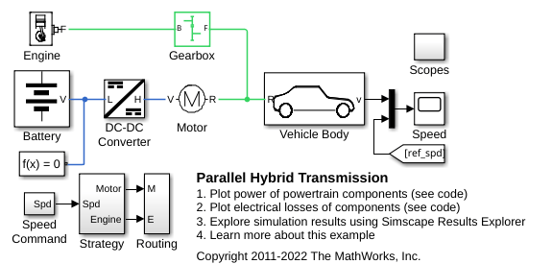
Parallel Hybrid Transmission
The basic architecture of a parallel hybrid transmission. Electrical power is applied in parallel with the combustion engine power. The electrical torque is applied at the wheel axle, but it could also be applied to the engine flywheel. In this test, the vehicle accelerates, maintains the faster speed, and then decelerates back to the original speed. The power management strategy uses just electrical power to effect the maneuver, the combustion engine only delivering the power required to maintain the original speed.
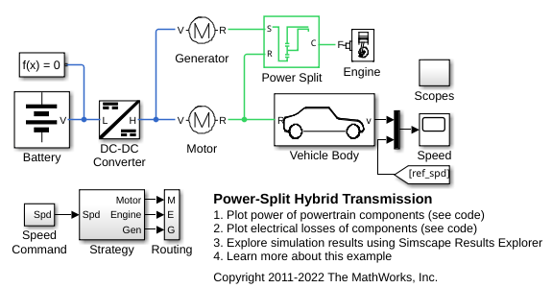
Power-Split Hybrid Transmission
The basic architecture of a power-split hybrid transmission. The planetary gear, along with the motor and generator, acts like a variable ratio gear. In this test, the vehicle accelerates, maintains the faster speed, and then decelerates back to the original speed. The power management strategy uses just stored electrical power to effect the maneuver, the combustion engine only delivering the power required to maintain the original speed.
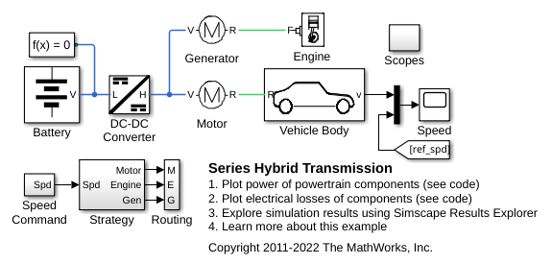
Series Hybrid Transmission
The basic architecture of a series hybrid transmission. All mechanical power from the engine is converted to electrical power via the generator. In this test, the vehicle accelerates, maintains the faster speed, and then decelerates back to the original speed. The power management strategy uses just stored electrical power to effect the maneuver, the combustion engine only delivering the power required to maintain the original speed.
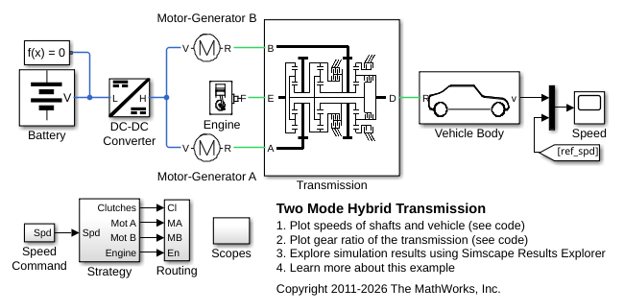
Two Mode Hybrid Transmission
The basic architecture of a two mode hybrid transmission. It consists of three planetary gear sets and four clutches. This combination permits four fixed gear ratios plus two power-split modes. The power split modes are used to transition between fixed gear ratios and for heavy acceleration/deceleration. The fixed ratios help with efficiency when cruising. For the first power split (input-split regime), only Clutch 1 is engaged. For the second power split (compound-split regime), only Clutch 2 is engaged. Engaging two clutches simultaneously removes one degree of freedom and hence results in a fixed ratio.
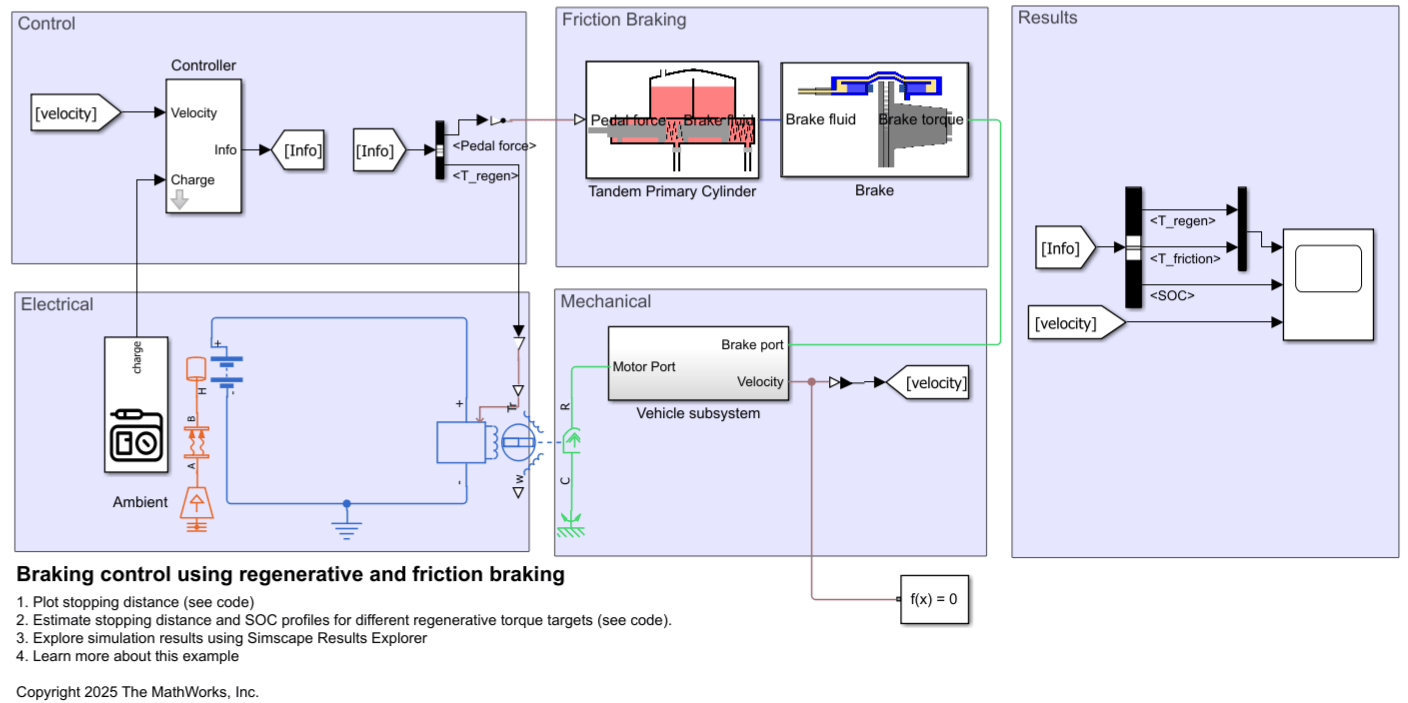
Regenerative and Friction Braking Control
Model a regenerative braking system in vehicles. Regenerative braking systems in vehicles capture and store energy that would otherwise be lost during braking. Specifically, regenerative braking systems convert vehicle kinetic energy to electrical energy, which would otherwise be dissipated as heat. This electrical energy returns to the battery where the vehicle can use it. Modeling a regenerative braking system allows you to predict the behavior of a design, compare several designs, and find the optimal design.

